Fuel system
Fuel system consists of five internal tanks and one optional external tank.
Description
Internal fuel is carried in five self-sealing, unpressurized wing cells. There are two inboard, two outboard, and one center tank. Approximately 250 gallons of usable fuel are split between those tanks.
Fuel from outboard tanks flows to the inner tanks and then to the center tank, all by gravity. Center tank includes a sump portion, which acts as an engine feed tank.
Engine-driven boost pumps allow to feed the engine.
| Tank capacity | ||
|---|---|---|
| GALLONS | POUNDS | |
| Wing outboard (2 tanks) | 79 | 514 |
| Wing inboard (2 tanks) | 138 | 897 |
| Center/feed | 38 | 247 |
| TOTAL | 255 | 1658 |
External tank
External fuel can be optionally carried in a single 150 gallons tank installed at the centerline fuselage station.
This tank can be added or removed from the EFB:
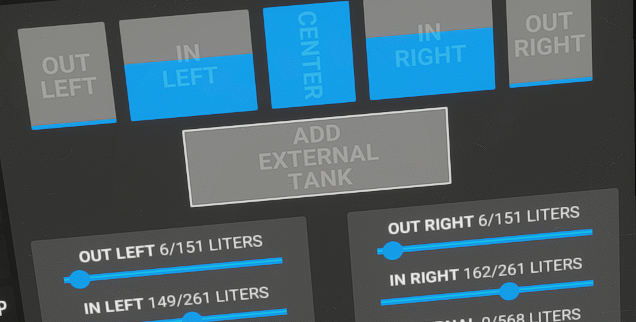
Another 230 gallons external tank exists but is not implemented on our aircraft.
Fuel is transferred from the external tank to the wing center/feed tank by an electrically driven transfer pump in the external fuel transfer line. It is manually switched on using EXT FUEL TRANS switch. Normal rate of transfer from the external tank is 750 pounds per hour (115 GPH). Fuel is transferred to the center tank, and may flow to inboard/outboard tanks if center tank is full already.
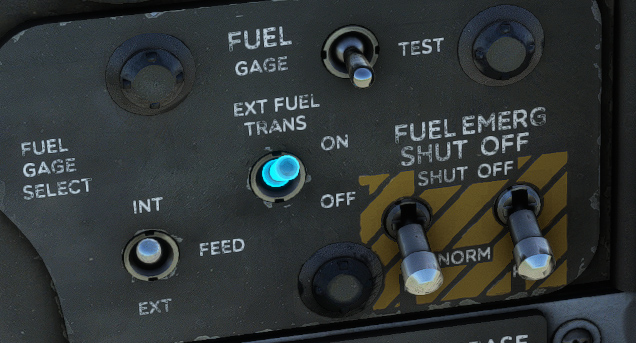
Pump should be turned off once all external tank fuel has been transferred, to prevent the transfer pump from running dry.
Fuel gauge
Fuel gauge is positioned on the bottom right of instrument panel and indicates fuel level (in LBS x 100) depending on fuel gage select switch position:
-
Internal fuel (five tanks).
-
Feed tank (center tank).
-
External fuel.
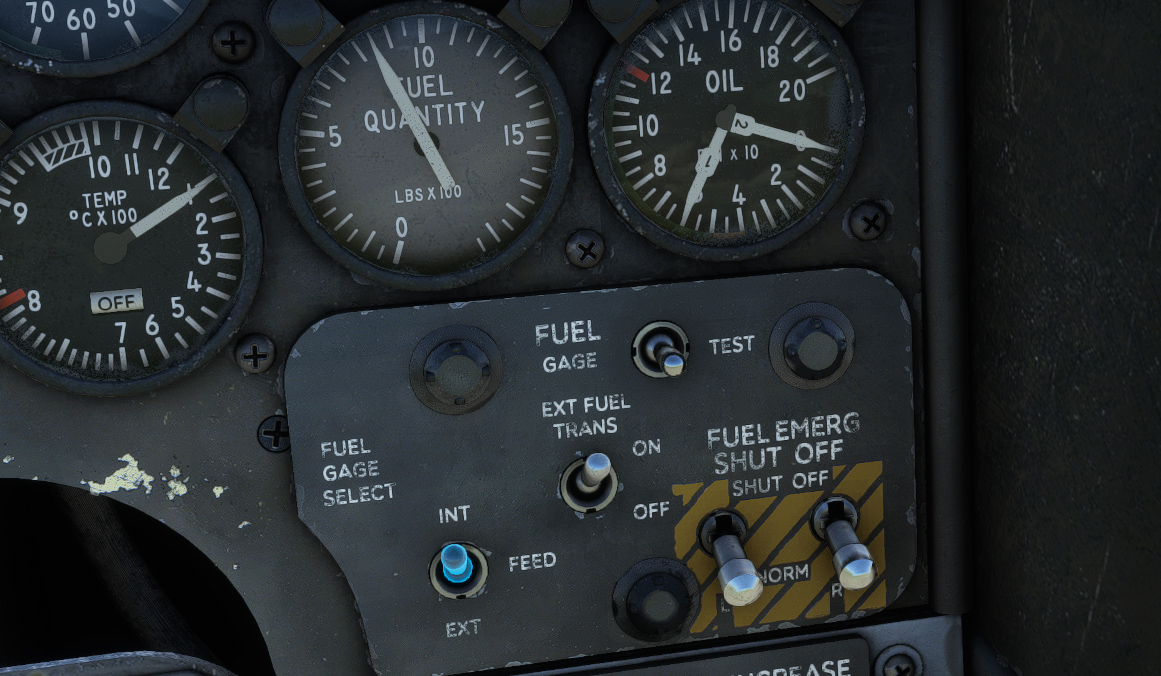
In order to test the gauge, an unstable switch can be held to the right and should result in the indicator monitoring toward zero.