Flight controls
The Jaguar features:
-
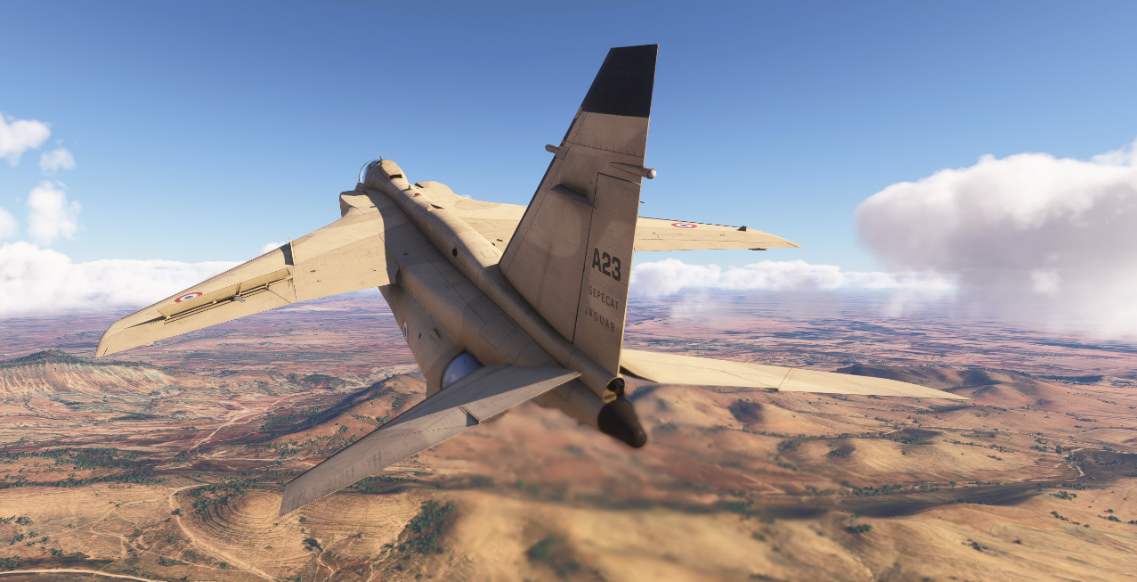
Two independent horizontal stabilizers.
-
Two spoilers mounted ahead of the wing trailing edge.
-
One vertical stabilizer.
The horizontal stabilizers serve both as elevator (simultaneous movement) and as aileron-like control surfaces (differential movement), as the aircraft does not have ailerons.
The pilot controls these surfaces via servo-actuators.
Servo control system
The aircraft’s flight controls are powered by hydraulic servo actuators, which assist the pilot in maneuvering the aircraft while ensuring stability and responsiveness. The system is designed with redundancy, using the two independent hydraulic circuits to maintain control even in case of a failure.
-
Elevators and rudder are controlled mechanically (directly by pilot input) and electrically (via the autopilot and stability augmentation system).
-
Spoilers are controlled mechanically by the control stick but can also receive automatic inputs for roll control.
In normal operation, hydraulic pressure moves the control surfaces based on pilot input. If the system detects excessive pressure differences, it automatically adjusts to prevent abrupt movements.
When the auto-stabilization system is engaged, the flight controls receive automatic corrections to improve stability. The system ensures smooth operation by regulating hydraulic pressure based on real-time flight conditions.
Yoke
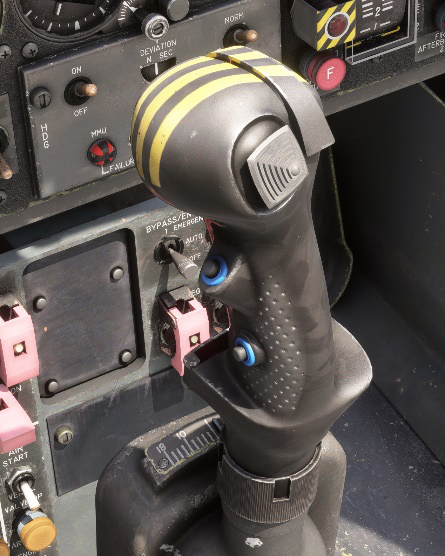
The yoke consists of a rectangular-section tube housing the aileron control linkage.
-
The pilot’s grip is mounted on an articulated joint for smooth operation.
-
Pitch and roll trim are adjusted via a four-way switch, which automatically returns to neutral when released.
-
A disengage button for auto-stabilization and autopilot is located at the base of the grip for quick manual override.
Lateral system
The roll control system transmits pilot inputs from the control stick to the servo actuators. It consists of:
-
A force feedback system (AJAX) to provide consistent control effort.
-
A trim system for adjusting neutral stick position.
-
Ailerons for primary roll control.
-
A differential deflection mechanism of horizontal stabilizer to improve roll authority at low speeds.
Force feedback (AJAX)
The AJAX system ensures that control forces remain predictable regardless of flight conditions. It automatically adjusts the resistance felt by the pilot based on airspeed and aircraft configuration.
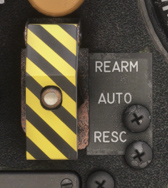
A control switch allows the pilot to select between:
-
Normal operation (AUTO): The system adjusts forces automatically.
-
Backup mode (RESC): A reduced-function fallback mode.
-
Reset mode (REARM): Used to clear system faults.
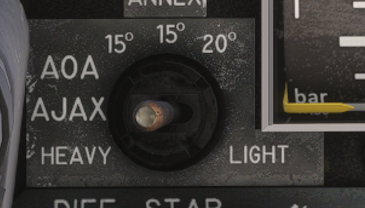
A gain selector also lets the pilot choosing between higher or lower control effort depending on preference.
Spoilers
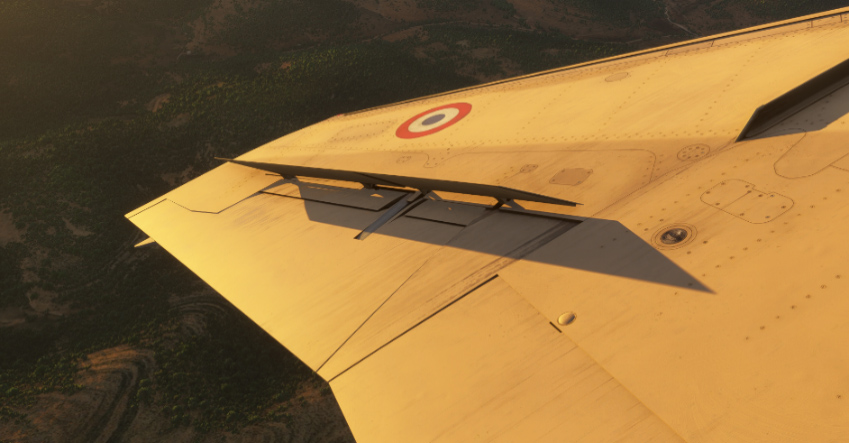
Spoilers, mounted ahead of the trailing edge, assist roll control by disrupting airflow over the wings. They become more active as speed increases and supplement the ailerons in high-speed flight.
Differential deflection mechanism
The tailplanes can move differentially (up to ±6°) to assist roll control below 425 knots.
The system operates in three modes:
-
AUTO: Differential deflection varies with speed. Below 200 knots, the system applies ±6° of differential movement. Between 200 and 425 knots, differential deflection decreases progressively. Above 425 knots, differential deflection is disabled.
-
OFF: Differential function is disabled, both surfaces move symmetrically.
-
MANUAL: Pilot can manually engage maximum differential deflection (±6°) at any speed. A blue indicator light confirms its activation. The transition to full deflection takes three seconds.
Mode is selected with a yellow stripped handle:
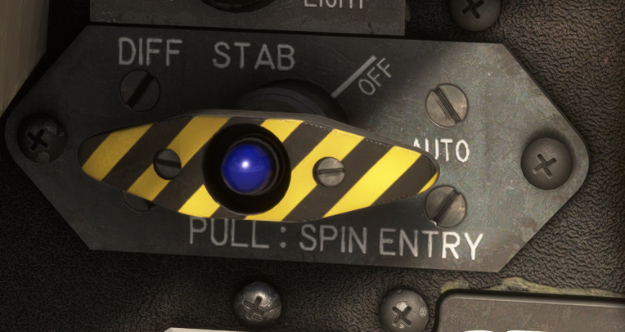
In manual mode, speed must be limited to 200 knots.
Rudder
Rudder control is working similarly as roll control with a force feedback system (AJAX) and a trim.
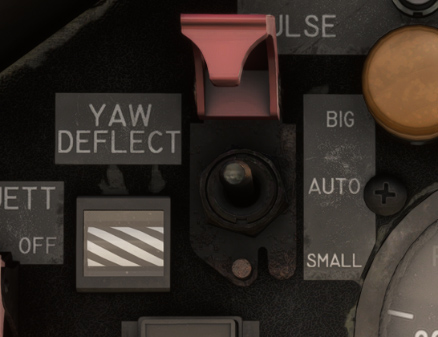
Rudder surface deflection is variable:
-
Higher deflection during approach to maintain control.
-
Lower deflection at high speed to limit efforts applied to the control surface.
A switch allows to force low deflection (small triangle indicated) or high deflection (big triangle indicated), and is kept in AUTO position by default. In AUTO position, higher deflection is enabled when landing gear is down.
Longitudinal system
The elevator control system transmits pilot inputs from the control stick to the elevators, adjusting pitch as needed. The system includes:
-
A force feedback system (AJAX) to provide consistent control effort.
-
A trim system to adjust the neutral position of the yoke.
-
A damping system (dash-pot) to smooth out rapid control movements.
Pitch damping
The damper helps stabilizing pitch movements by adding resistance based on the speed of control inputs. It also adjusts slightly based on airspeed. The system operates independently of the main hydraulics and includes a heating system to maintain performance.
Trim
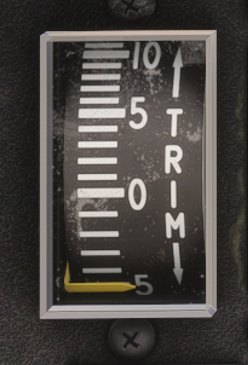
Electrical trim allows to do adjustments on three axes (pitch, roll, yaw).
Roll and pitch trim is managed using the mushroom knob on the control stick. An indicator shows the current position of pitch trim (from -5° to 10°):
Rudder trim is managed with a switch on the left console, and a small indicator indicated:
-
Left rudder trim (left arrow).
-
Neutral rudder trim.
-
Right rudder trim (right arrow).