Fuel system
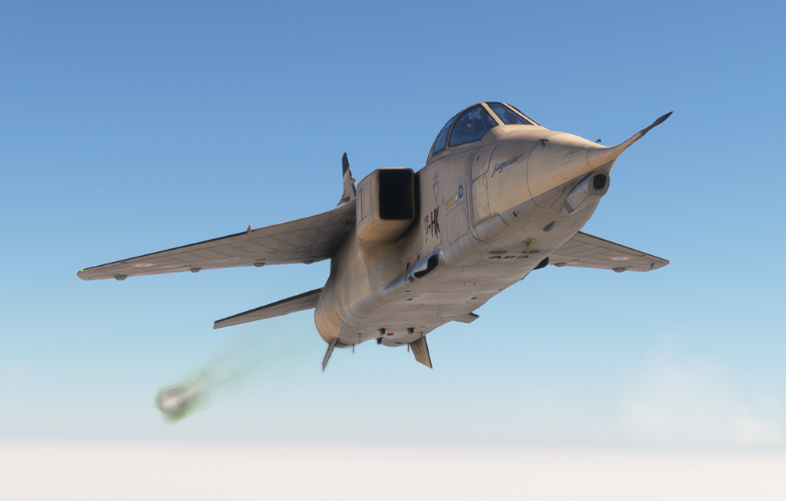
The Jaguar has a complex fuel system consisting of eight internal tanks, with the possibility to add up to three external tanks.
Fuel transfer is conducted automatically during the whole flight to ensure the aircraft is always centered correctly.
Description
Internal tanks are separated in three groups: forward, central, back.
| Group | Tank name | Capacity | Weight (TR4 fuel) |
|---|---|---|---|
| Forward | N1 | 40 gal / 150 L | 254 lbs / 115 kg |
| N2 | 40 gal / 150 L | 254 lbs / 115 kg | |
| F1 | 165 gal / 625 L | 1,060 lbs / 481 kg | |
| Central | V1 | 258 gal / 975 L | 1,656 lbs / 751 kg |
| V2 | |||
| F2 | 301 gal / 1,140 L | 1,936 lbs / 878 kg | |
| F3 | |||
| Back | F4 | 302 gal / 1,145 L | 1,942 lbs / 881 kg |
| TOTAL | 1,105 gal / 4,185 L | 7,103 lbs / 3,222 kg |
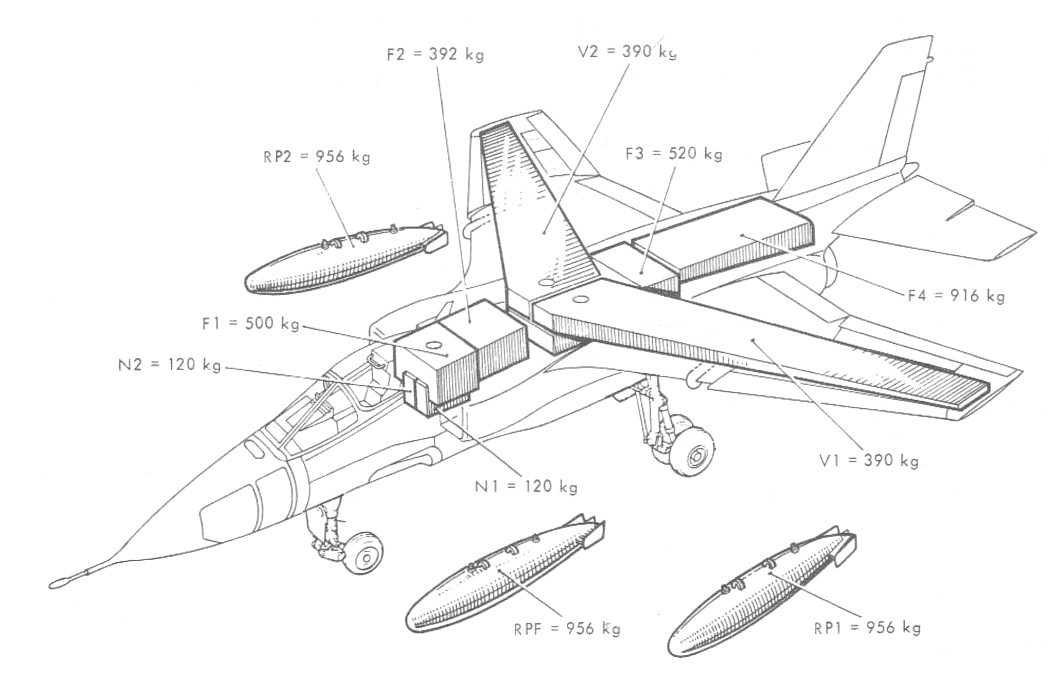
N1 and N2 tanks are connected to left and right engine (respectively). They are the only tanks having a flexible structure.
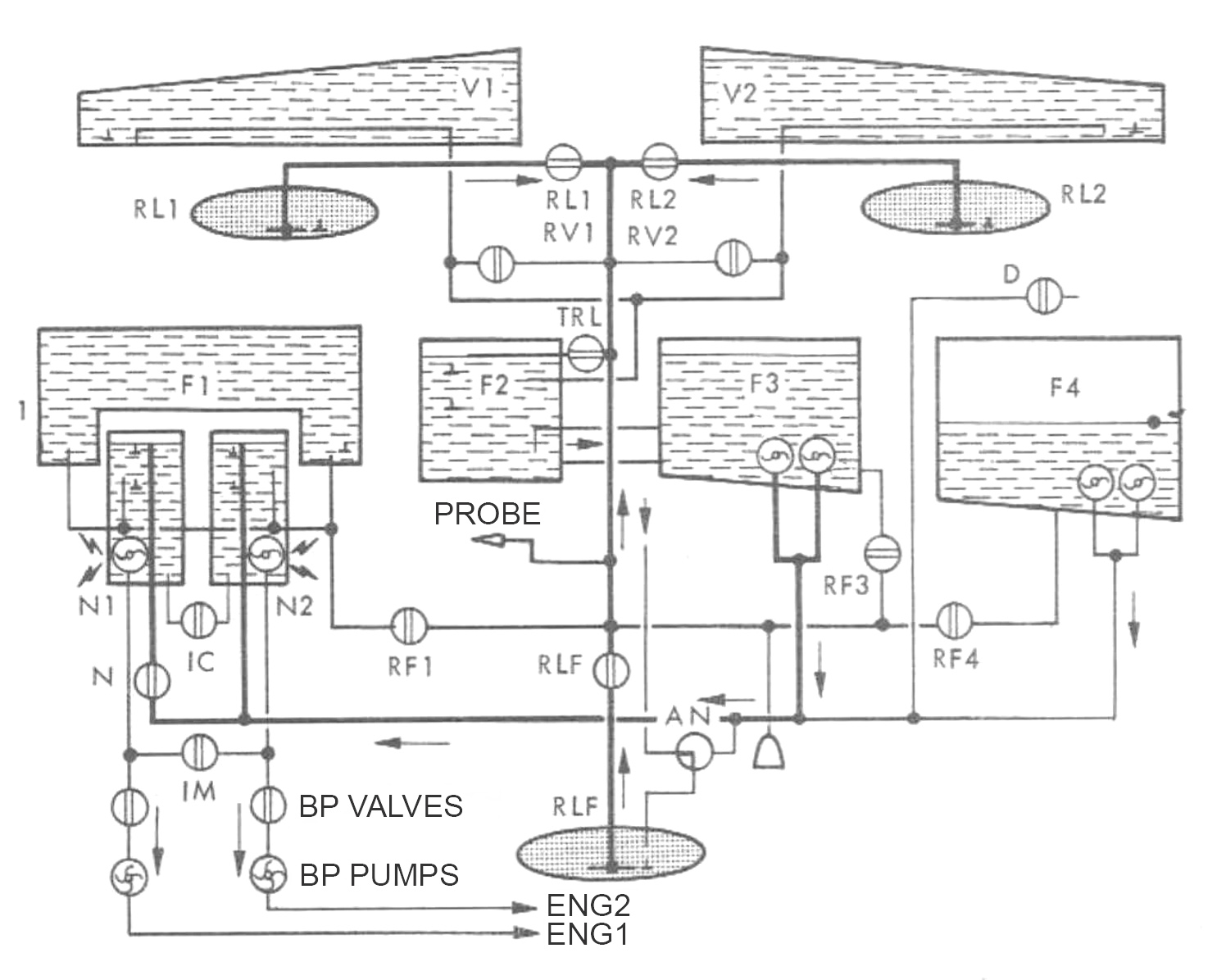
F2 and F3 tanks are directly connected. Transfer between other tanks is managed with the help of several electro-valves.
All tanks (except N1, N2, F2/F3 and F4 which enclose transfer pumps) are pressurized with air taken from the engines.
Here is a diagram of the circuit:
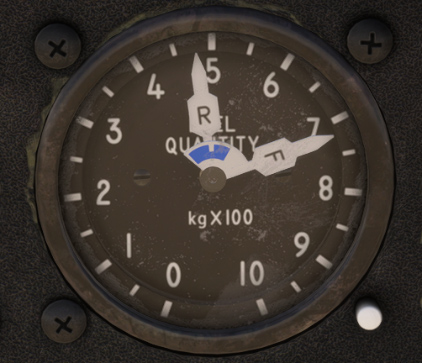
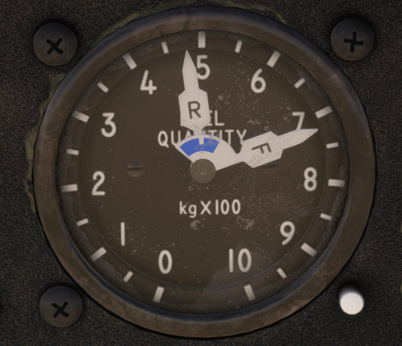
To follow fuel quantity remaining in each tank, a gauge on main panel shows the following information:
-
“F” (front) gauge represents fuel weight in F1, N1 and N2 tanks (cumulated).
-
“R” (rear) gauge represents fuel weight in F4.
A blue zone on the first needle shows the sector where “AR” needle should remain in order for the aircraft to be correctly centered. The automatic fuel transfer is made to stay in this tolerance zone.
In addition, fuel control panel shows for each tank if it is full, partially full or empty, as described here.
After each refuel, a totalizer is set by the pilot to display the total fuel weight embarked in the aircraft. This totalizer is automatically updated with fuel consumption to show at any time the total fuel remaining. Jettisoned fuel is not taken into account by the totalizer. The totalizer does not show the units which stay at zero.
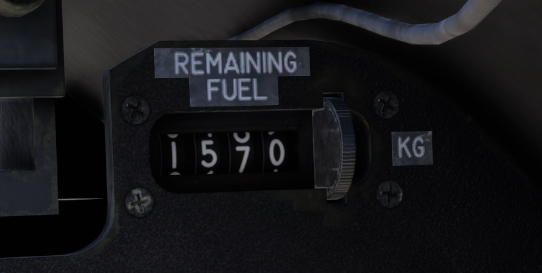
A button on the EFB allows to set the totalizer automatically.
External fuel
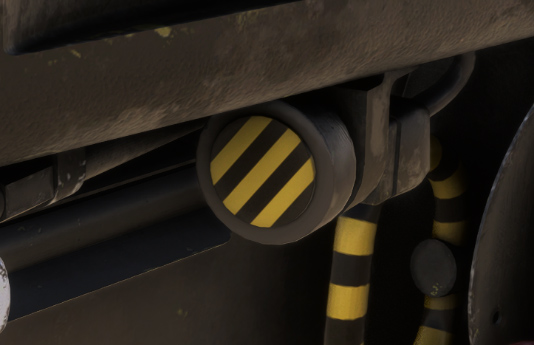
Both A and GR1 have the same 1,195 liters external tanks (slightly different design, but same capacity).
The aircraft can carry up to three external tanks (one on the belly, one below each wing).
External tanks can be added from the EFB (fuel page or weapons page).
In case of emergency during the flight, they can be jettisoned with all other external stores from a button above left console.
Fuel transfer
Fuel transfer is conducted automatically during the whole flight, in order to keep the aircraft centered.
A small panel allows to monitor and manage everything related to the fuel system:
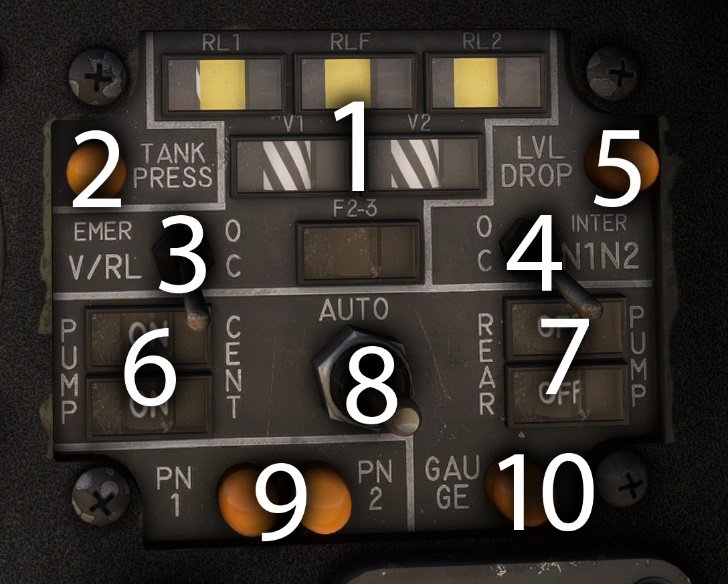
| # | Description | # | Description |
|---|---|---|---|
| 1 | Fuel tanks level indicator (three states) | 6 | F3 pumps active |
| 2 | Tanks pressurization failure light | 7 | F4 pumps active |
| 3 | V1 and V2 valves emergency opening | 8 | Transfer pumps mode (F3 – AUTO – F4) |
| 4 | N1 and N2 intercom valve opening | 9 | Feed pump failure (N1/N2) |
| 5 | Level dropping in N1/N2 light | 10 | Fuel transfer anomaly light |
As fuel quantity gauge does not show the exact quantity in all fuel tanks, fuel tank indicators show in the other tanks (RL1, RLF, RL2, V1, V2 and F2/F3) the following:
-
Yellow background if tank is empty.
-
Zebra pattern background if tank is partially filled.
-
Black background if tank is full.
Tanks are emptying following this sequence:
- F4 fuel is transferred to N1 and N2 using the two immersed pumps, until 475 kg (1,047 lbs) of fuel remains in F4. At this moment, “R” needle is located on “F” needle mark.
-
F3 fuel is transferred to N1 and N2 using the two immersed pumps. As F2 is connected to F3, it results in the consumption of fuel contained in external tanks (RL1, RL2, RLF) and in wing tanks (V1, V2). Once F3 is empty, immersed pumps are stopped. Only fuel remaining is in F1, F4, N1 and N2.
-
F4 pumps are supplied again and F1 valves are opened in order to empty F1 and F4 tanks at the same time.
-
N1 and N2 tanks are feeding the engine. “N1-N2” alarm will be triggered when 200 kg (441 lbs) of fuel is remaining in the aircraft.
Please note that N1 and N2 intercom valve is not always opened. In the case where only fuel remaining is inside N1 and N2, you may need to open this valve manually from the control panel to ensure both engines are fed.
Fuel dump
In case of emergency, fuel can be dumped in order to reduce aircraft weight prior to landing.
A switch behind a protection hood is used to open fuel dumping valve.
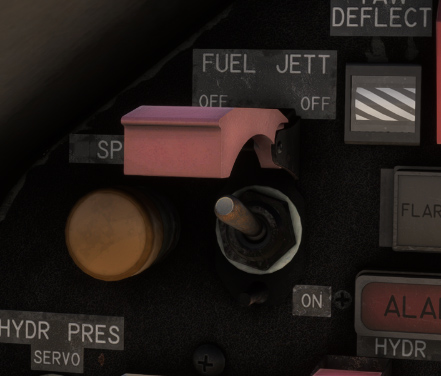
Fuel is ejected from a pipe placed in the rear of the aircraft, above the parachute cone.