Fuel system
Tanks
First Transall versions used to carry only two tanks per wing, which limited the range for long flights with little payload. For the second series of aircraft (S/N > 201), a third tank has been added, raising the total fuel capacity to 29,690 liters.
Fuel is divided as follows (for each wing):
-
Tank “A”: 5,740 liters, located in the middle of the wing.
-
Tank “B”: 4,285 liters, located between tank A and wing tip.
-
Tank “C”: 4,815 liters, located between tank A and wing root.
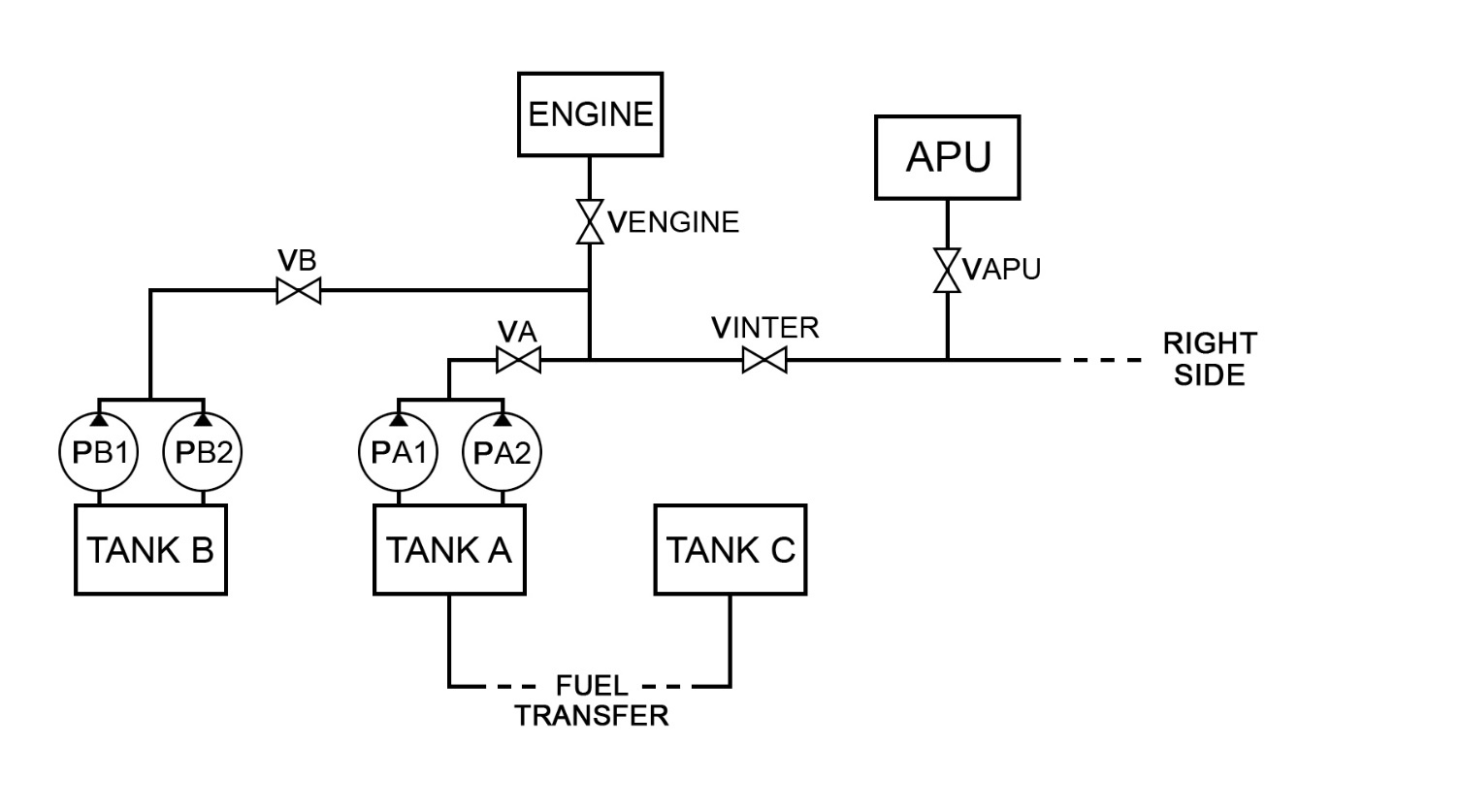
Tanks A and B are directly connected to fuel lines feeding engines and APU, while tanks C are isolated from the main fuel system and used as additional tanks if needed. Their content can be transferred to tanks A and B with a complex transfer system described in fuel transfer section.
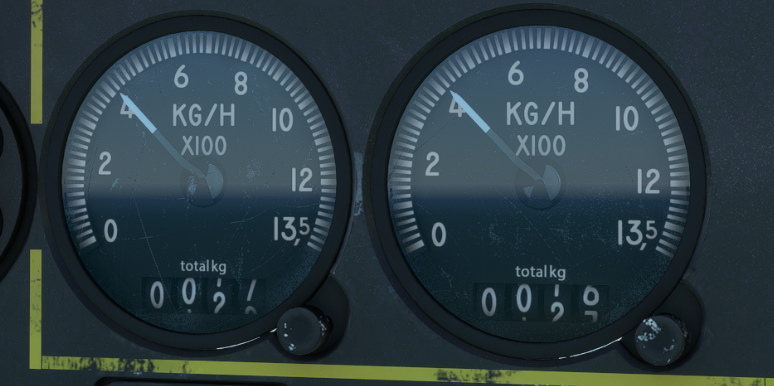
Fuel consumed by the engines can be monitored from fuel flow indicators, and can be reset with the associated knobs. Left gauge also takes into account APU fuel consumption.
Pumps & valves
As fuel tanks are located higher than engines and APU, gravity is sufficient in most cases to feed the engines. However, in certain conditions, for example when reservoirs are near empty, you will need to use electric pumps to get enough fuel pressure. Each tank A and B has two immersed pumps, that can be controlled with their dedicated switches on the center console.
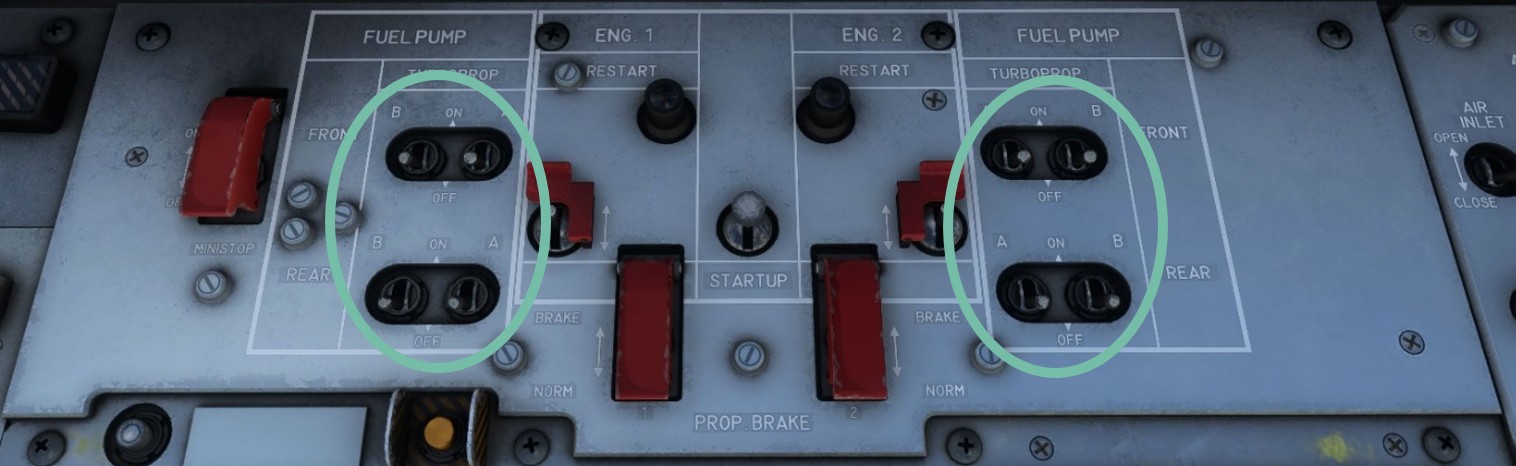
Those pumps should be functioning from the takeoff until landing to ensure a sufficient fuel pressure.
Several fuel valves allow to isolate each tank, left and right fuel lines, engines and APU. All of them are located on left and right sides of top console.
From left to right (pilot seat view):
-
“VAPU”, APU isolation valve.
-
“VInterleft”, left fuel lines isolation valve.
-
“VBleft”, left tank B isolation valve.
-
“VAleft”, left tank A isolation valve.
-
“VAright, right tank A isolation valve.
-
“VBright”, right tank B isolation valve.
-
“VInterright”, right fuel lines isolation valve.
-
Fuel dump valve.
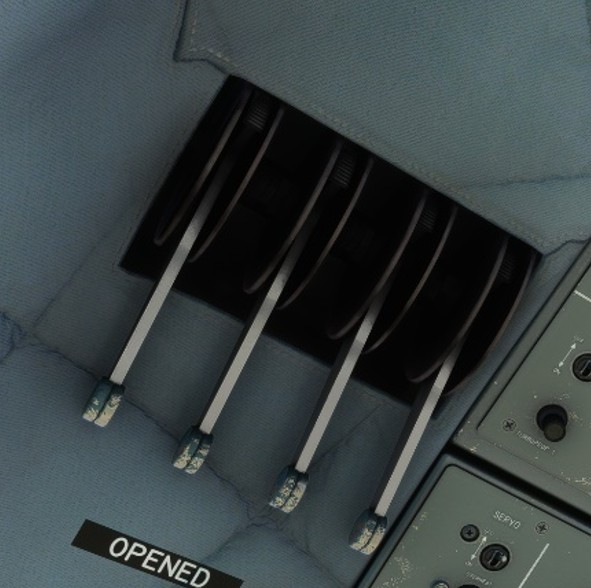
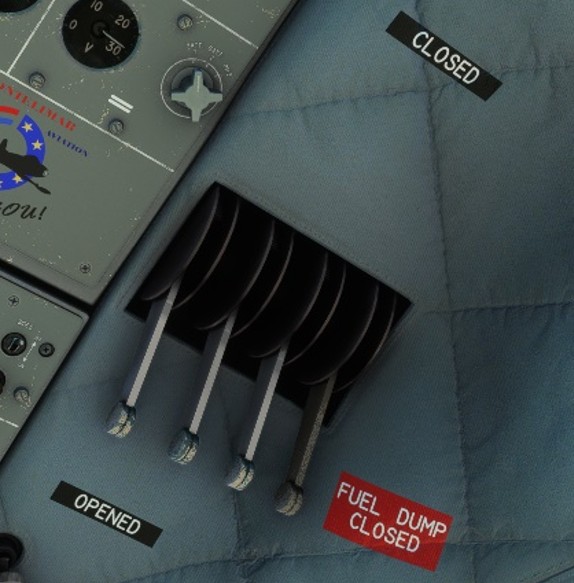
In case of engine fire, a cut-off valve directly located nearby the engine (or APU) can isolate the concerned engine or the APU from the rest of the fuel system.
Once fuel cut-off handle has been rotated, “REARM” buttons should be pressed to re-open the valve that has been shut.
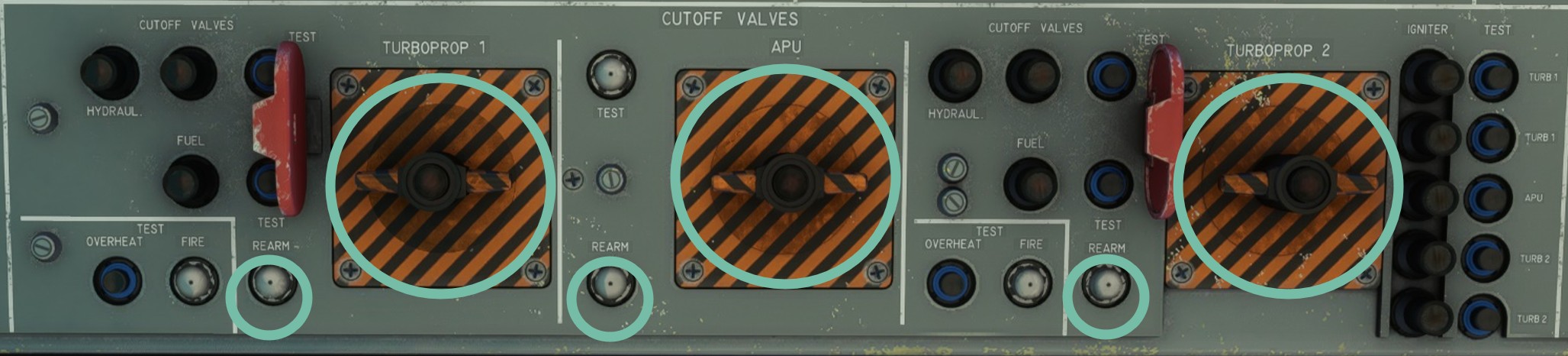
Main engine valves do not have any manual handle but are automatically closed when condition levers are put in shut-off position.
Here is a detailed diagram of fuel system with tanks, lines, valves and pumps. Only left side is depicted as fuel system is symmetrical.
Refill
Tanks can be filled instantly from the fuel menu or from the tablet.
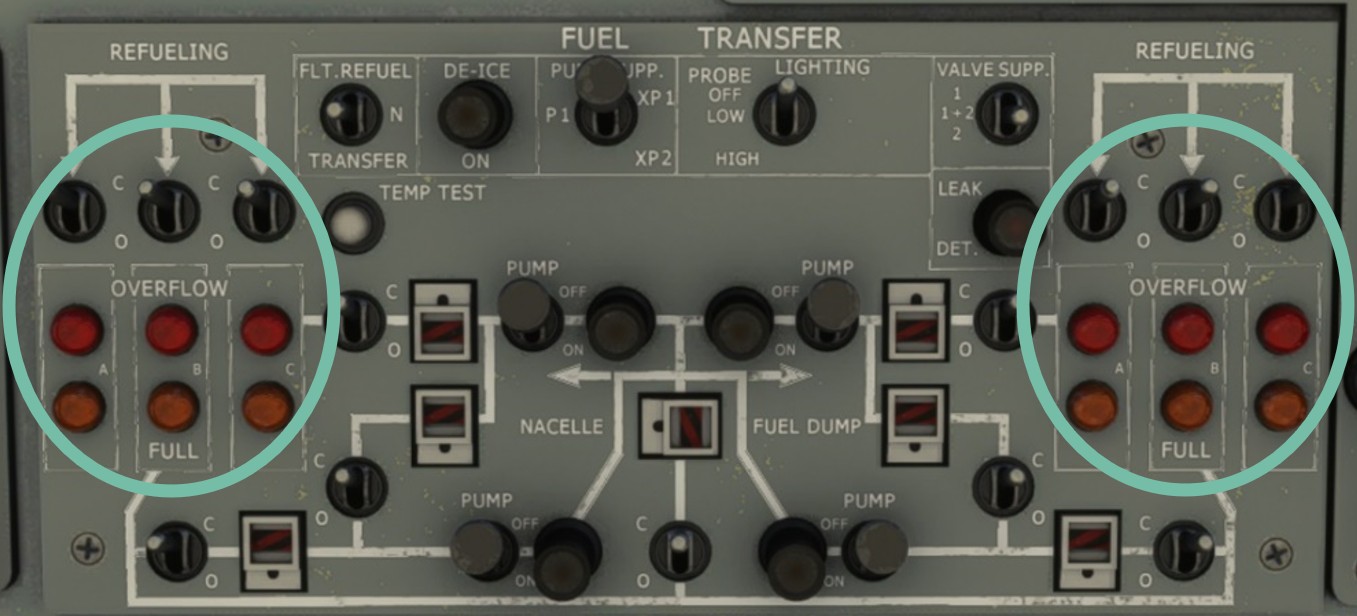
For more realism, fuel transfer panel can be used to refill, after fuel truck is called from the ATC ground services and connected. Refueling switches can be put on “OPEN” position to start the refueling.
One light per tank indicates when it is full.
Transfer & dump
As tanks C are not directly connected to the engines, a complex fuel network allows to transfer fuel between tanks A and C, on both sides of the aircraft. This same network is used to dump fuel in case of emergency.
This network is completely separated from engines feeding circuit described previously, and is composed of:
-
Four electrical pumps.
-
Seven fuel valves.
Each valve can be openeded as needed to begin a fuel transfer with the help of fuel pumps. The panel directly shows fuel pathway along transfer lines.
Each of the pumps allows to push fuel out of the tank it is connected to.
In the following configuration, fuel will be pumped out of right tank C to be transferred to right tank A:
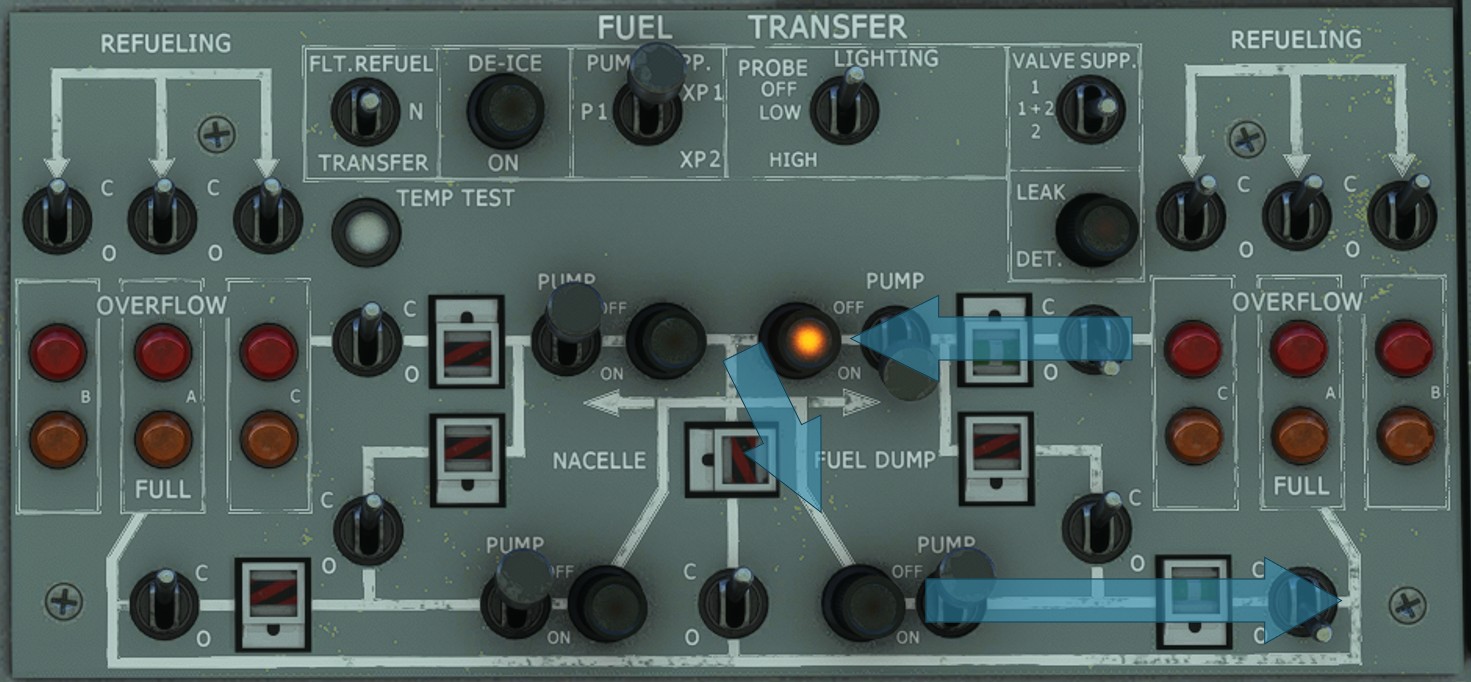
In the following configuration, fuel will be pumped out of right tank C to be transferred to left tank A:
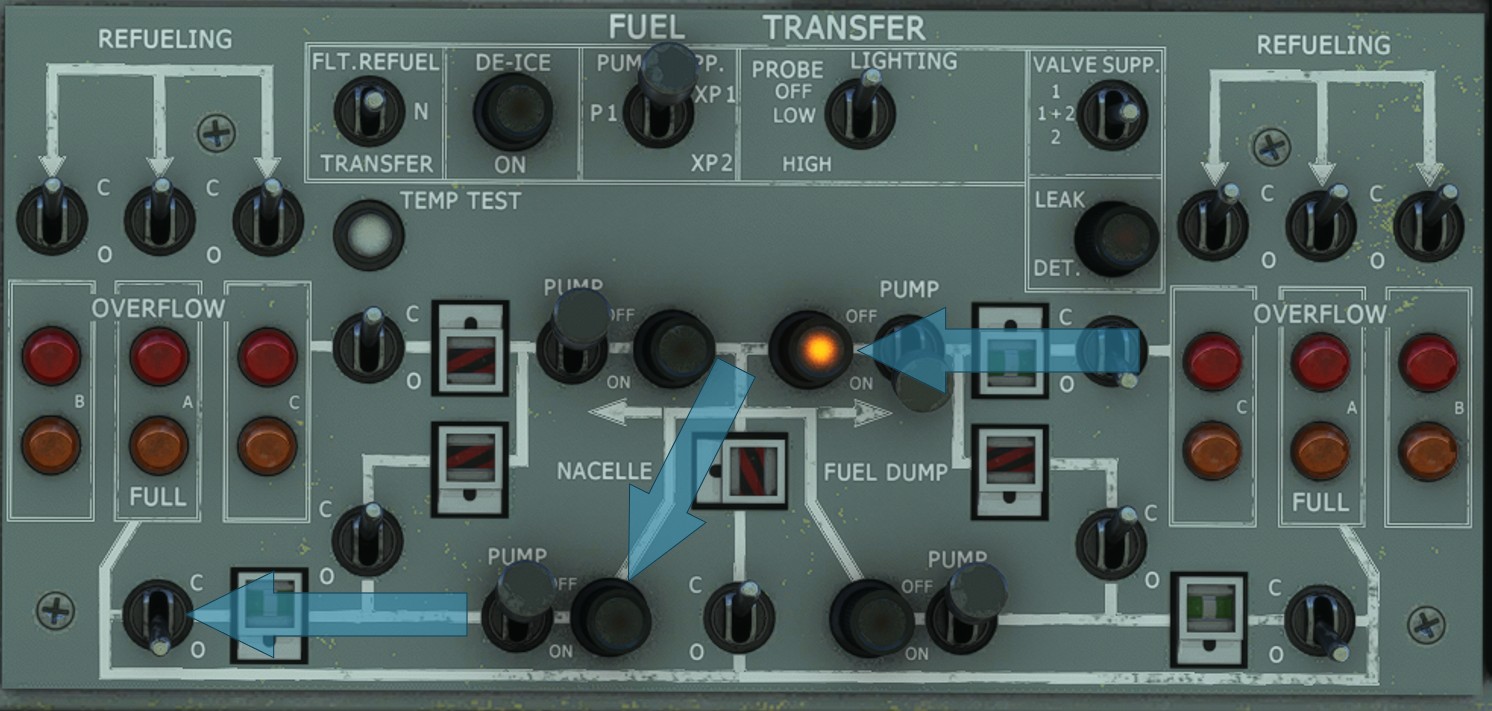
To dump fuel, valve associated to the tank to drain should be opened, and the associated pump turned on. Opening fuel dump valve handle will initiate fuel dumping.
Fuel circulates through pipes to the rear of the aircraft to be ejected from the nozzle serving this purpose.
In the following configuration, tanks C on both sides are drained:
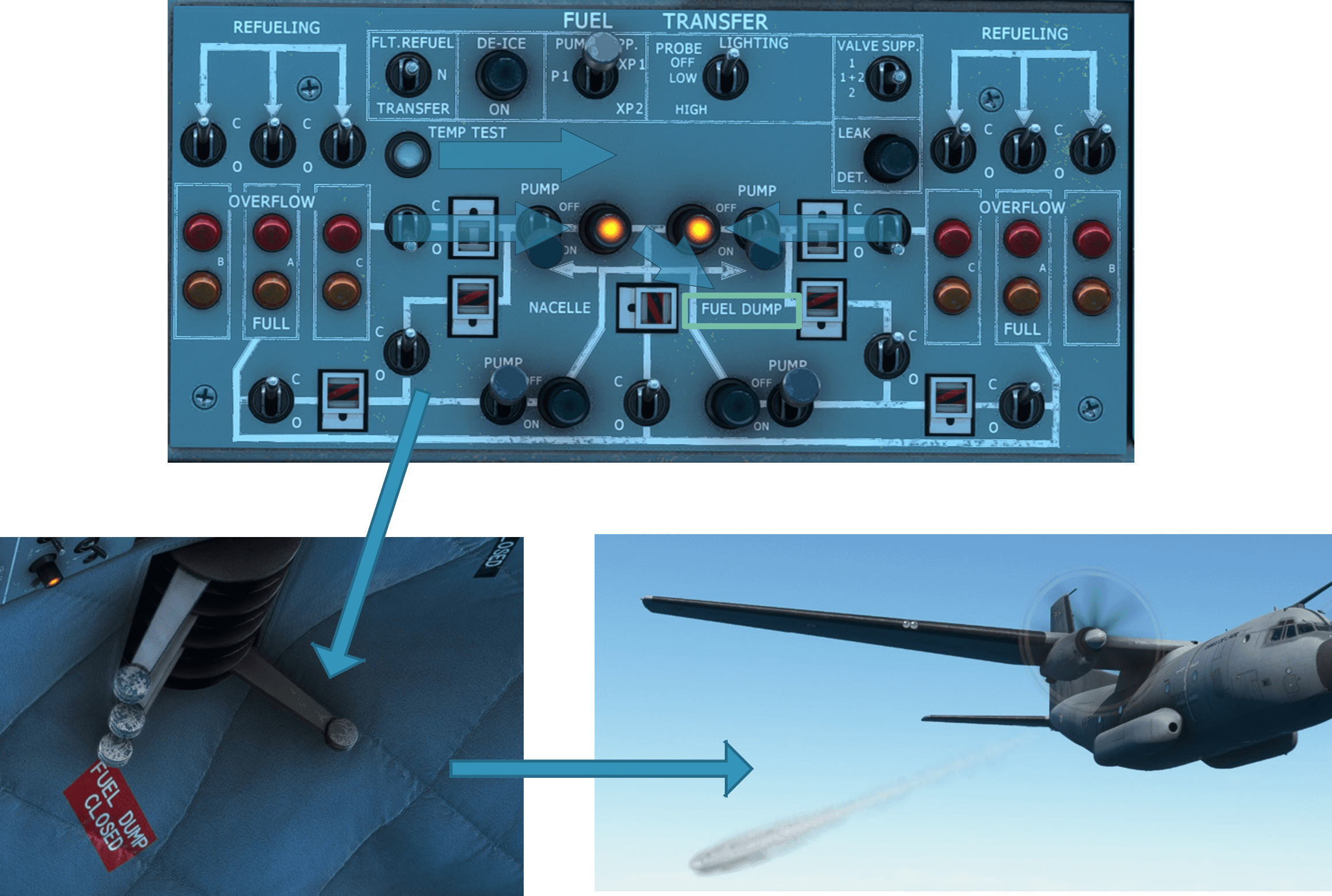
Because of limitations with current fuel system implementation, fuel can be transferred from tanks C to tanks A, but not the opposite.