Engines
Powerplant overview
Engines
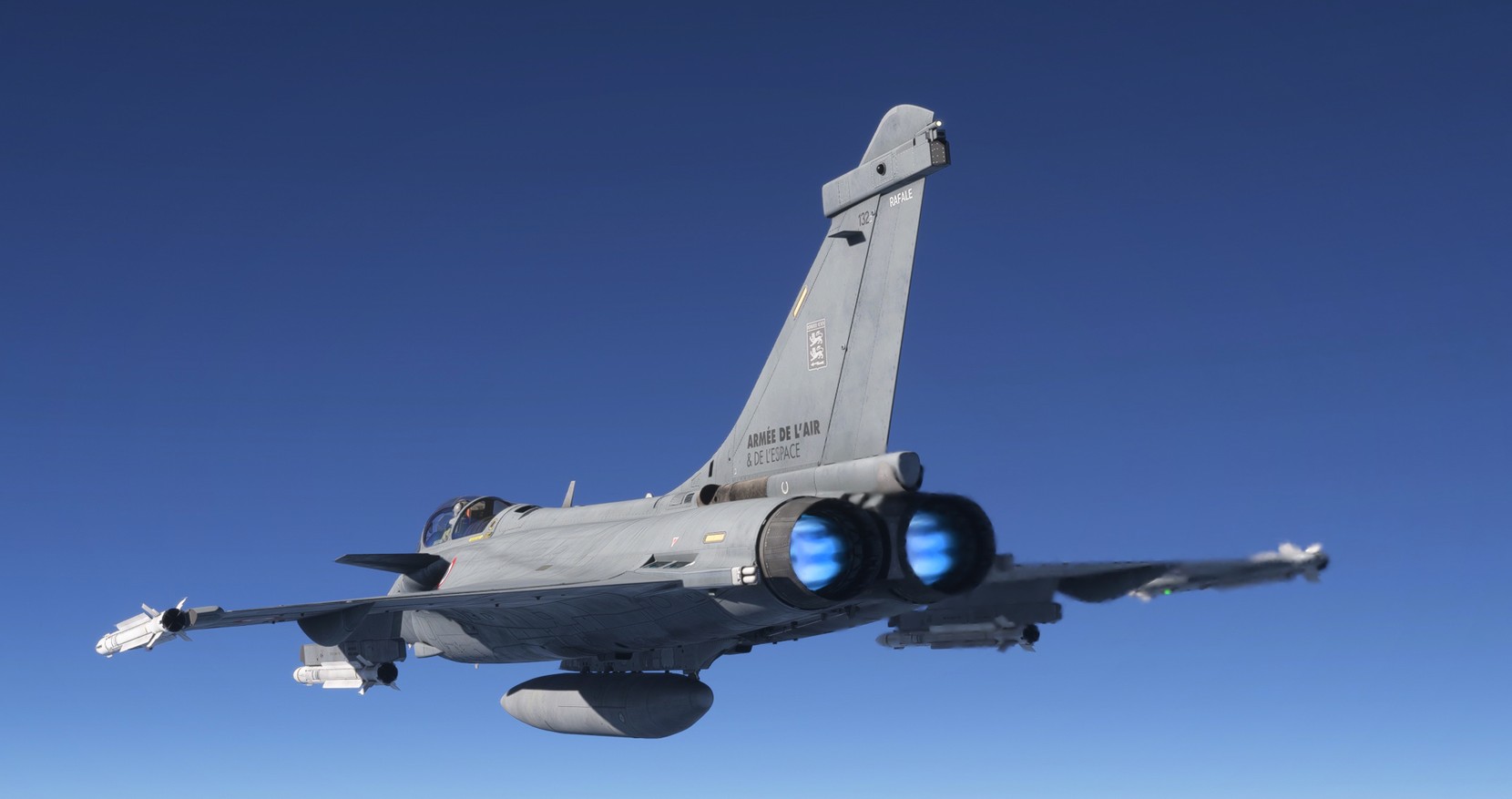
The aircraft is powered by two Safran M88 afterburning turbofan engines.
Each engine is installed in a dedicated bay on either side of the rear fuselage.
The M88 is a two-spool, dual-flow turbofan engine and has the following characteristics:
| Maximum dry thrust | 11,200 lbf / 50 kN |
| Maximum afterburner thrust | 16,500 lbf / 75 kN |
| Max Rated N2 | 17,650 RPM |
| Max Air Flow | 65 kg/s |
| Compression Ratio | 24.5 |
| Turbine inlet temperature | 1,500 °C |
| Engine Mass | 900 kg |
| Time from idle to full dry | ~ 4 seconds |
| Fuel consumption* (idle) | ~ 10 kg/min |
| Fuel consumption* (full dry) | 100-150 kg/min |
| Fuel consumption* (afterburner) | Up to 450 kg/min |
Fuel consumption is for both engines and is indicative only as it depends on a lot of factors.
The two-engine installation provides both performance and redundancy.

Thanks to its performance, the Rafale is capable of supercruising at Mach 1.4, meaning that, at a suitable altitude and in a clean configuration, it can reach this speed without using afterburner.
Auxiliary power unit
The aircraft is equipped with an internal Rubis 3 auxiliary power unit (APU).
The APU provides two types of energy:
- Pneumatic power (bleed air) for cockpit air conditioning on the ground, and for engines starting.
- Electrical power through its connection to a generator, supplying onboard equipment before engine starting.
The APU can be used both on the ground and in flight. For engine start, it supplies the bleed air required to start the engines, with the capability to start one engine at a time only.
Engine controls
Throttle
The throttle is used for normal engine control.
It is a combined control (mono-throttle), meaning both engines receive the same thrust command in normal operation. This reduces yaw caused by asymmetric thrust.
Throttle travel is divided into two sections, separated by a physical detent:
- Dry thrust range.
- Afterburner range.
Do not forget to check controls assignments section, explaining how to bind your hardware.
Auxiliary engine control (AEC)
The two auxiliary controls allow each engine to be controlled independently.
Each provides four distinct functions:
-
STOP: engine fuel shutoff valve closed, shuts the engine down. -
IDLE: engine idle, used during startup sequence. -
NORM: normal flight position, engine controlled by the mono-throttle. -
FIX: engine power frozen at its current value.
An indicator above each AEC illuminates red in the event of a critical engine failure or fire.
The FIX position is useful when a precise thrust setting must be maintained, for example during air-to-air refueling.
To hold one engine at a fixed setting:
- Set the desired engine RPM / power with the main throttle.
- Move the corresponding AEC to
FIX. - The mono-throttle will then only affect the other engine left in
NORM.
Operation
Startup
Compared to older aircraft, the Rafale startup sequence is simplified for the pilot. Engine start is managed from the main panel using the 5K knob.
In normal conditions, this single panel is enough to start the aircraft and both engines.
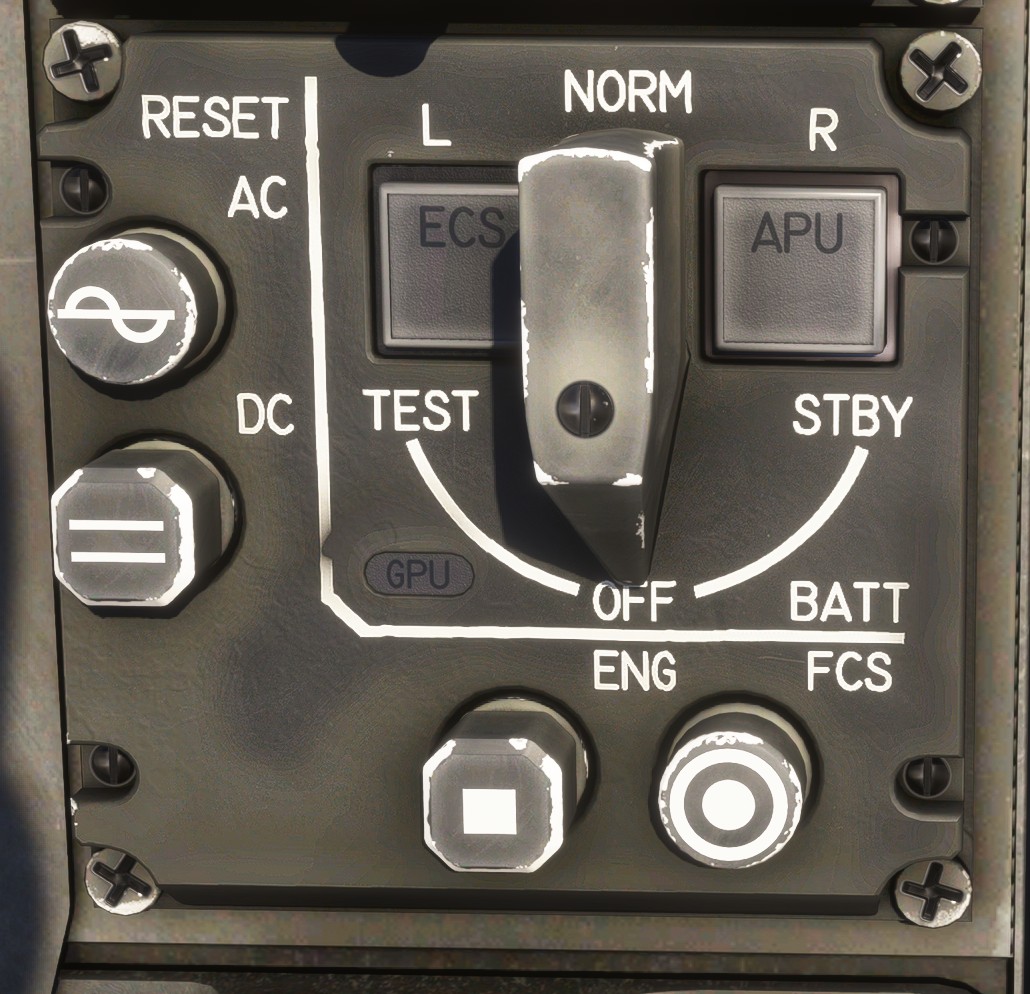
The 5K knob positions are:
TEST: test position mainly used for maintenance and for ECS and APU indicators testing.OFF: aircraft batteries are disconnected. No electricity inside the aircraft unless GPU is connected.STBY: essential battery bus is connected. Non-essential consumers are disconnected to save battery, except if an external electrical provider is connected (GPU, APU or engines generators).NORM: normal position with engines running. All electrical consumers are connected.L: left engine start position. This position is unstable.R: right engine start position. This position is unstable.
The GPU indicator is lit when GPU is connected and providing current.
APU button is used to start or stop the auxiliary power unit. The indicator is green once the APU is started and is flashing during the startup.
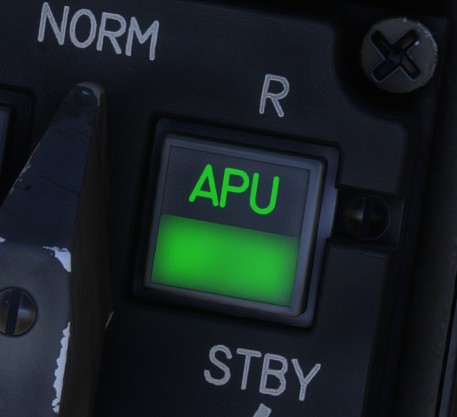
ECS button is used to enable air conditioning inside the cockpit while APU is running (using APU bleed air). The indicator is green when ECS is enabled and is flashing if APU is still starting.

Please note that all those functions are linked:
- If ECS is toggled with APU off, it will automatically start the APU, as APU bleed air is required.
- If 5K knob is put on
LorRpositions, APU will be started automatically before starting the engines.
Once both engines are started, the APU will automatically shut down except if ECS is enabled.
You can find more information about electrical circuit here.
Please refer to checklists for the complete startup procedure.
You can visualize a full startup sequence in this video:
Monitoring
All essential engine indications are grouped on the LD engine page.
In case of a malfunction, alerts and associated warnings are described in the alarms chapter.
MSFS does not allow in-flight restart by windmilling. In case of engine shutoff in flight, you will need to start the APU first in order to restart an engine.
High altitude
The officially stated operational ceiling is 50,000 feet, although the aircraft may be able to reach altitudes slightly above 60,000 feet.
At these altitudes, the engine control system progressively restricts access to the highest power settings, starting with the afterburner. This protects the engines against operating risks such as compressor stalls.
At high altitude, the afterburner takes on a blue colour due to changes in combustion conditions and the lower air density.