Alarms
Description
The aircraft features an ergonomic warning and alert system designed to remain as unobtrusive as possible to the pilot.
Only essential information is displayed on the avionics screens, while detailed information about active alarms is available on the LD FAIL page.
Under normal conditions, the system does not generate unnecessary warnings or alarms. For example, no warning is triggered when powering the aircraft from a cold & dark state.
The system includes several categories, listed below from highest to lowest priority:
-
Alerts, displayed on the HUD only. -
Alarms, divided into three categories (red,amberandmission) depending on severity.
The difference between an alert and an alarm is that an alarm may be acknowledged and muted by the pilot, whereas an alert remains displayed for as long as its triggering conditions are met.
Only the highest-priority alert is displayed at any given time. When multiple alarms are active simultaneously, they are automatically prioritized according to their severity.
Alarms panel
The main instrument panel includes a set of annunciator lights providing quick visual information about the aircraft status.
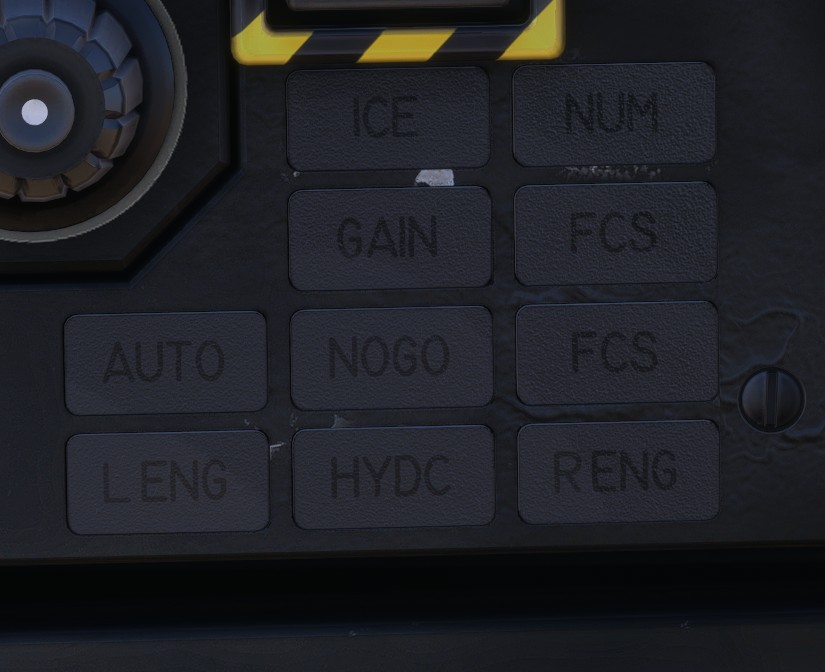
Each indicator may be triggered by multiple system conditions and is not necessarily associated with a single alarm.
Indicators can illuminate in three different colors depending on severity (blue for information, amber for caution, and red for failure).
| ICE | NUM | |
| Aircraft de-ice disabled in icing conditions | FCS digital mode failure | |
| GAIN | FCS | |
| FCS variable gain unavailable | FCS minor failure | |
| AUTO | NOGO | FCS |
| Autopilot coupling failure | NOGO alert | FCS major failure |
| L.ENG | HYDC | R.ENG |
| Left engine failure | Hydraulic system failure | Right engine failure |
Sound annunciations
The most critical alerts and alarms are accompanied by voice announcements generated by a female synthetic voice while the triggering conditions remain active.
Aural warnings can be tested using the Aural Alerts Switch.
For alarms, a warning tone is continuously played while the alarm remains active and has not been acknowledged. This tone may be played simultaneously with a voice announcement.
Autopilot / autothrottle disconnect sound
A "dong" tone is played whenever the autopilot or autothrottle disengages unexpectedly:
- Significant control input is applied while the autopilot is engaged.
- The FCS switches to analogue mode, or the spin switch is enabled while the autopilot or autothrottle is engaged.
- Throttle reaches a physical stop while the autothrottle is engaged.
Gear down radio bip
When the landing gear is fully extended, pressing the gear status indicator emits a continuous radio beep.
This feature is traditionally used by military pilots to confirm to air traffic control that the landing gear has been successfully extended prior to landing.
Alerts
Level 1
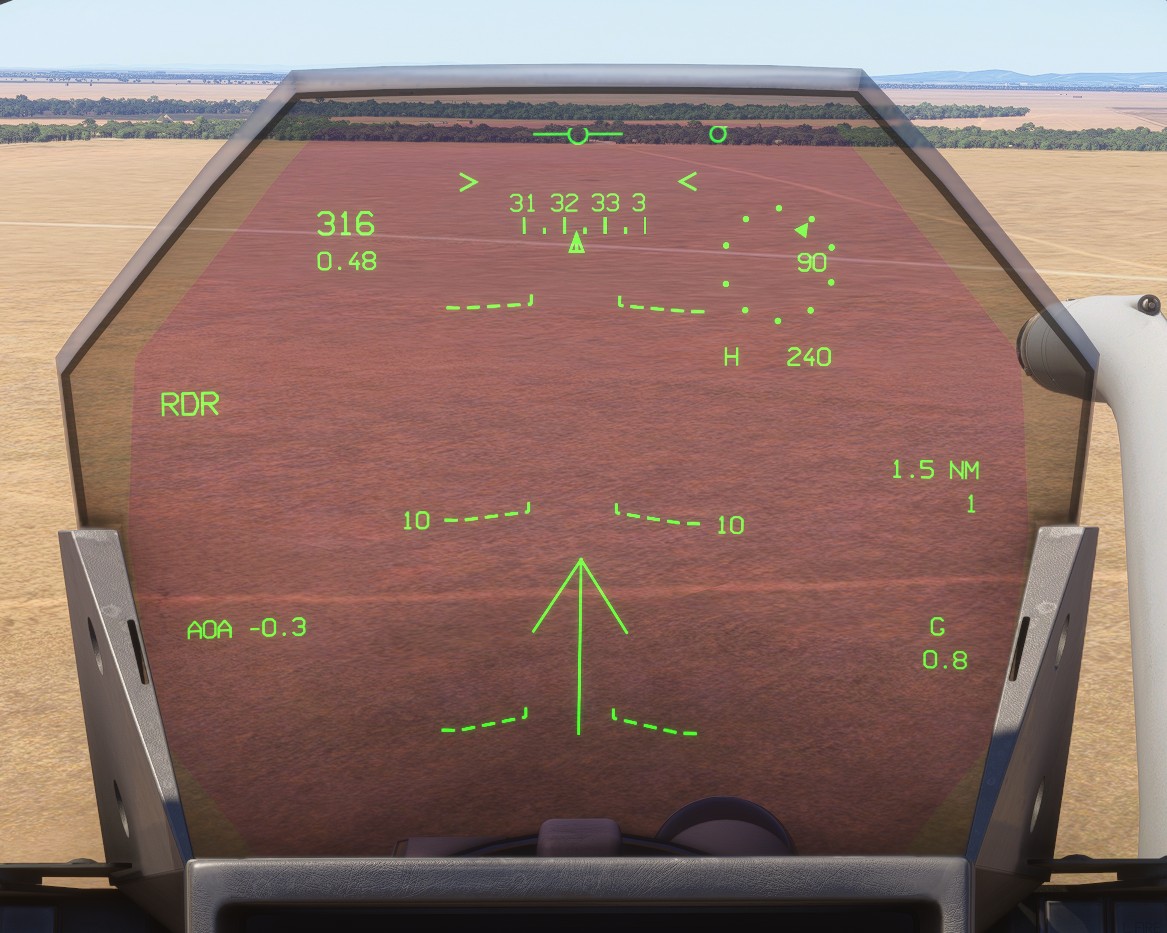
The safety height alert is the highest-priority alert and is specific to the HUD, as it is not displayed on any other screen.
It is triggered whenever the aircraft descends below the safety height selected by the pilot (200 feet by default).
The alert is inhibited in APP mode and remains active until the aircraft climbs back above the selected safety height.
It is displayed as a flashing upward arrow, prompting the pilot to immediately climb above the selected safety height.
Level 2
All other alerts belong to the "level 2" category.
These alerts indicate situations requiring immediate pilot attention or corrective action.
Only the highest-priority active alert is displayed.
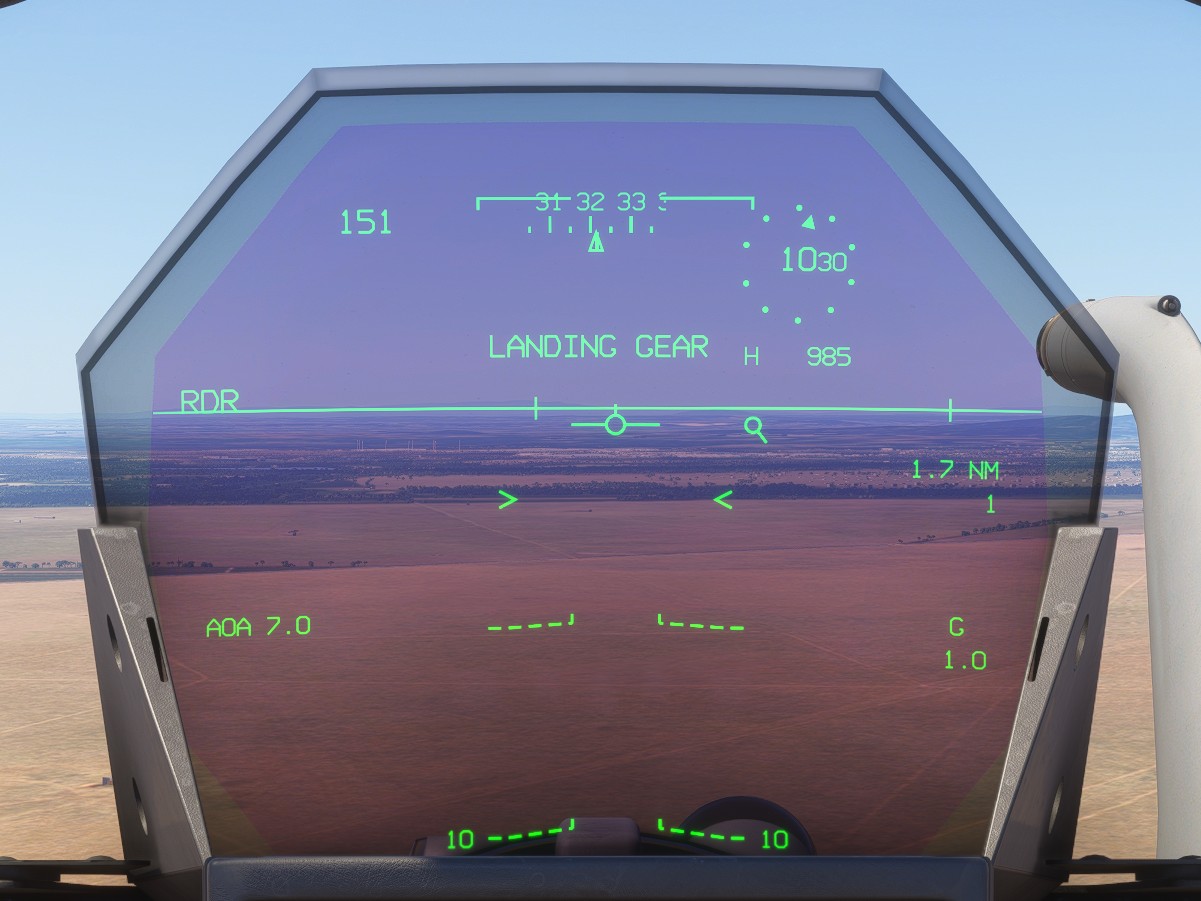
RELEASE STICK: the angle of attack exceeds 10° and the control stick is moved above elastic stop.RECOVER: the angle of attack exceeds 10°, the control stick is close to neutral, and the landing gear is not fully extended.TOO SLOW: indicated airspeed falls below 100 knots in flight, indicating an imminent stall risk.TOO FAST: indicated airspeed exceeds 750 knots at low altitude (risking structural overheating) OR Mach exceeds 0.95 with large external fuel tanks (RPL741) installed.LANDING GEAR: airspeed is below 165 kts, altitude is below 10,000 ft, at least one throttle is below 30%, and the landing gear is not fully extended.MASTER ARM: a combat mode is selected (inA/AorA/S) while the Master Weapons Switch is in theSAFEposition.TF ENVELOPE: terrain following is active and aircraft speed is approaching envelope limits.
Alarms
Alarms are divided in three categories (red, amber and mission).
A newly triggered alarm will make a box appear on main avionics screens, and can be acknowledged by clicking on this box (in a lateral display or in center display).
Clicking on the box opens LD FAIL page.
An active alarm remains indicated at the top of the lateral displays by its corresponding severity symbol, even after it has been acknowledged, to remind the pilot that the condition is still present.

Red alarms
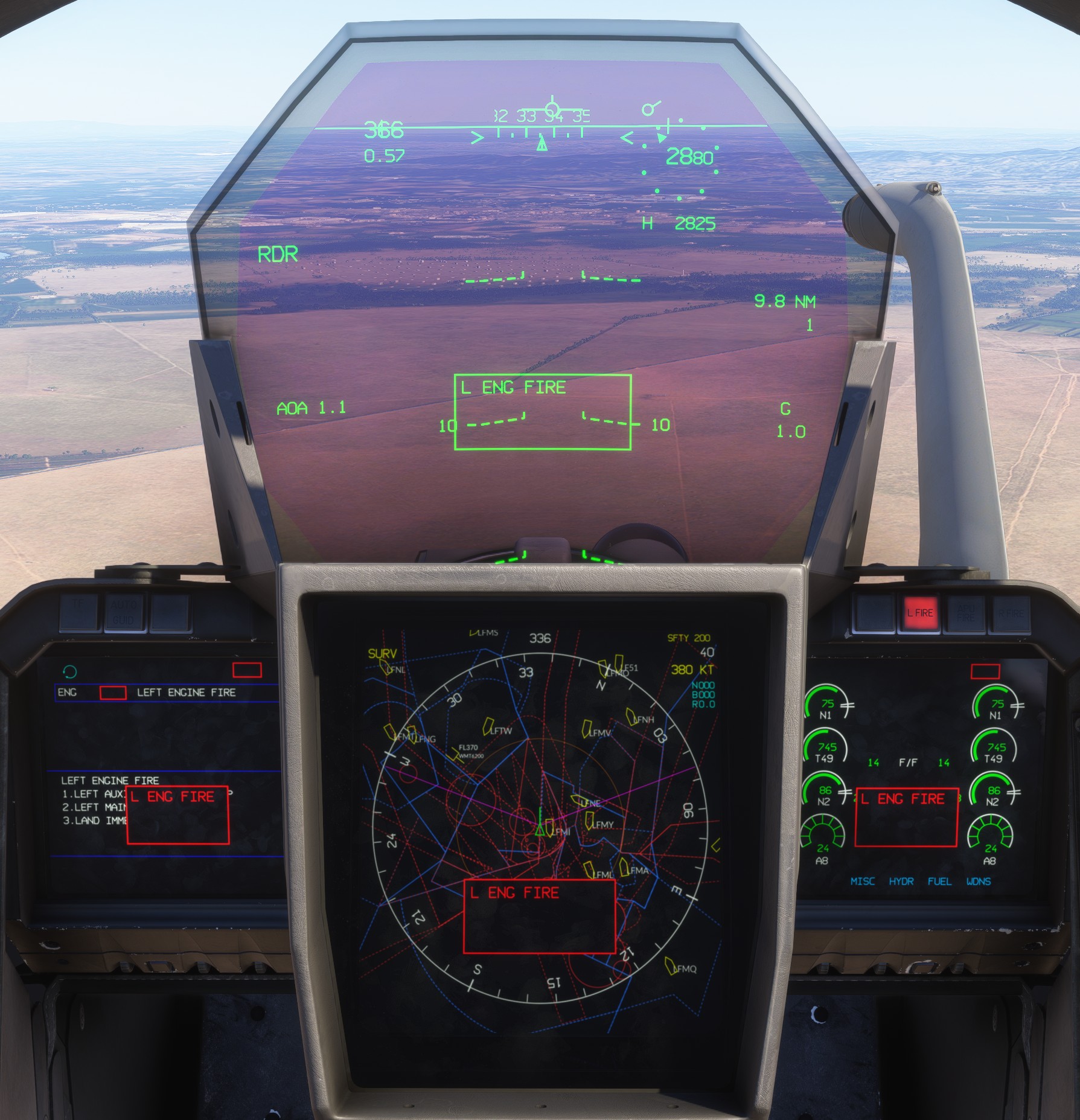
Red alarms indicate major failures requiring immediate attention.
List of implemented red alarms:
L ENG FIRE: left engine fire.R ENG FIRE: right engine fire.APU FIRE: APU fire.HYD FAIL: low pressure in both hydraulic circuits.
Active red alarms are displayed in a dedicated central warning box on all four main avionics displays. When multiple alarms are active, they are sorted by priority.
Amber alarms
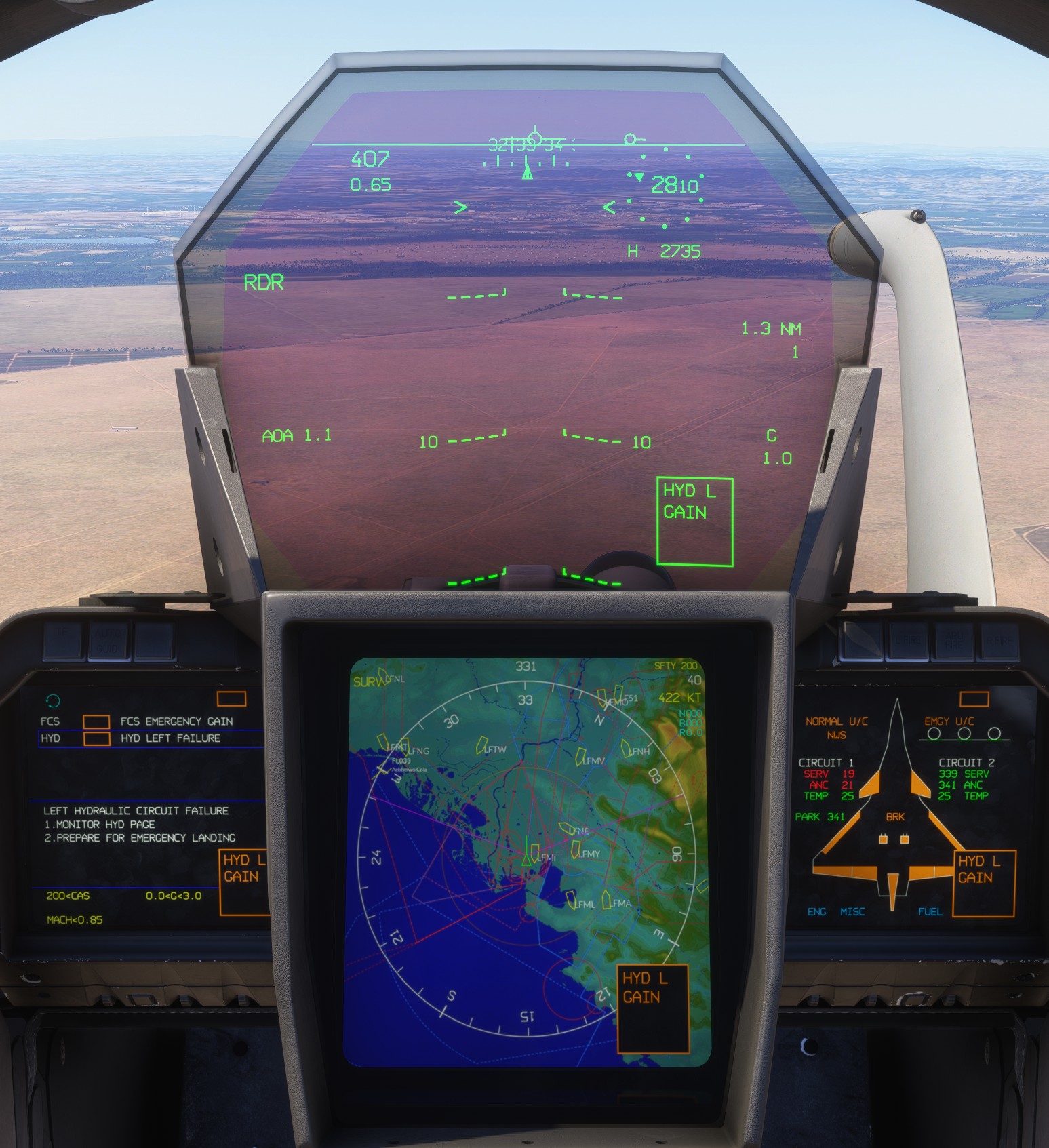
Amber alarms indicate failures or abnormal conditions requiring pilot attention but considered less critical than red alarms.
List of implemented amber alarms:
HYD L: low pressure in the left hydraulic circuit.HYD R: low pressure in the right hydraulic circuit.FUEL: at least one feeder tank contains less than 250 liters of fuel, or the discrepancy between the measured fuel quantity and the fuel totalizer exceeds 300 kg.OXY: the oxygen supply or regulator system is not operating normally.BINGO: remaining fuel quantity has fallen below the selected bingo value.FCS: both engines are running and the FCS test has not been completed successfully.CONF: the stores configuration switch is not set to the correct position.GAIN: emergency FCS gain is selected.L GEN: left generator is disconnected.R GEN: right generator is disconnected.
Amber alarms are displayed in a dedicated box located in the lower-right corner of the four main avionics displays.
This box is hidden whenever a red alarm is active and has not been acknowledged, ensuring that the pilot's attention remains focused on the highest-priority failure.
Mission alarms
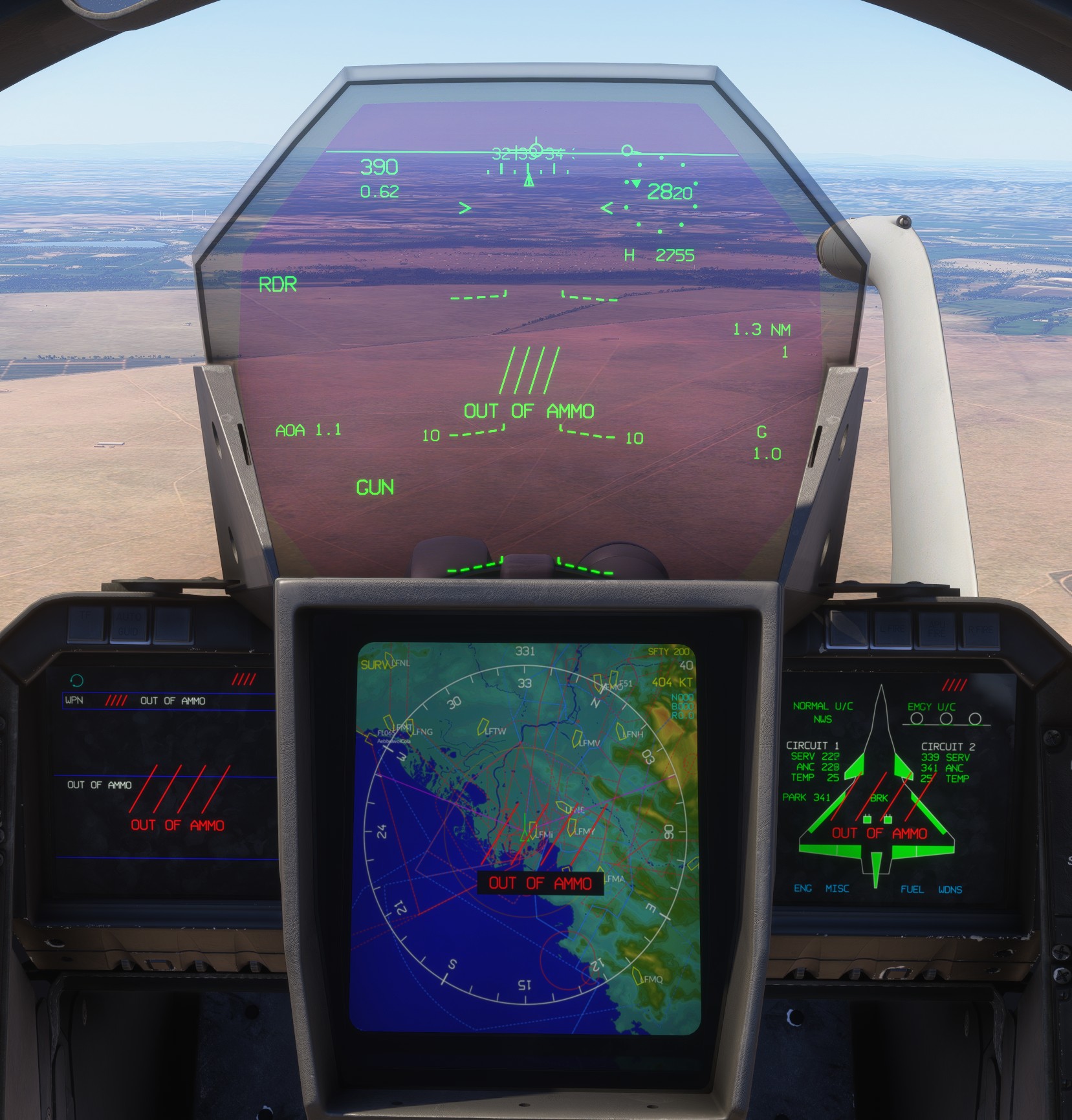
Mission alarms are displayed on the four main avionics screens using a striped symbol.
Only a limited number of mission alarms are currently implemented, as most are related to military systems and combat functions that are not relevant within the MSFS environment.
Currently implemented:
OUT OF AMMO: gun mode is selected and no ammunition remains.
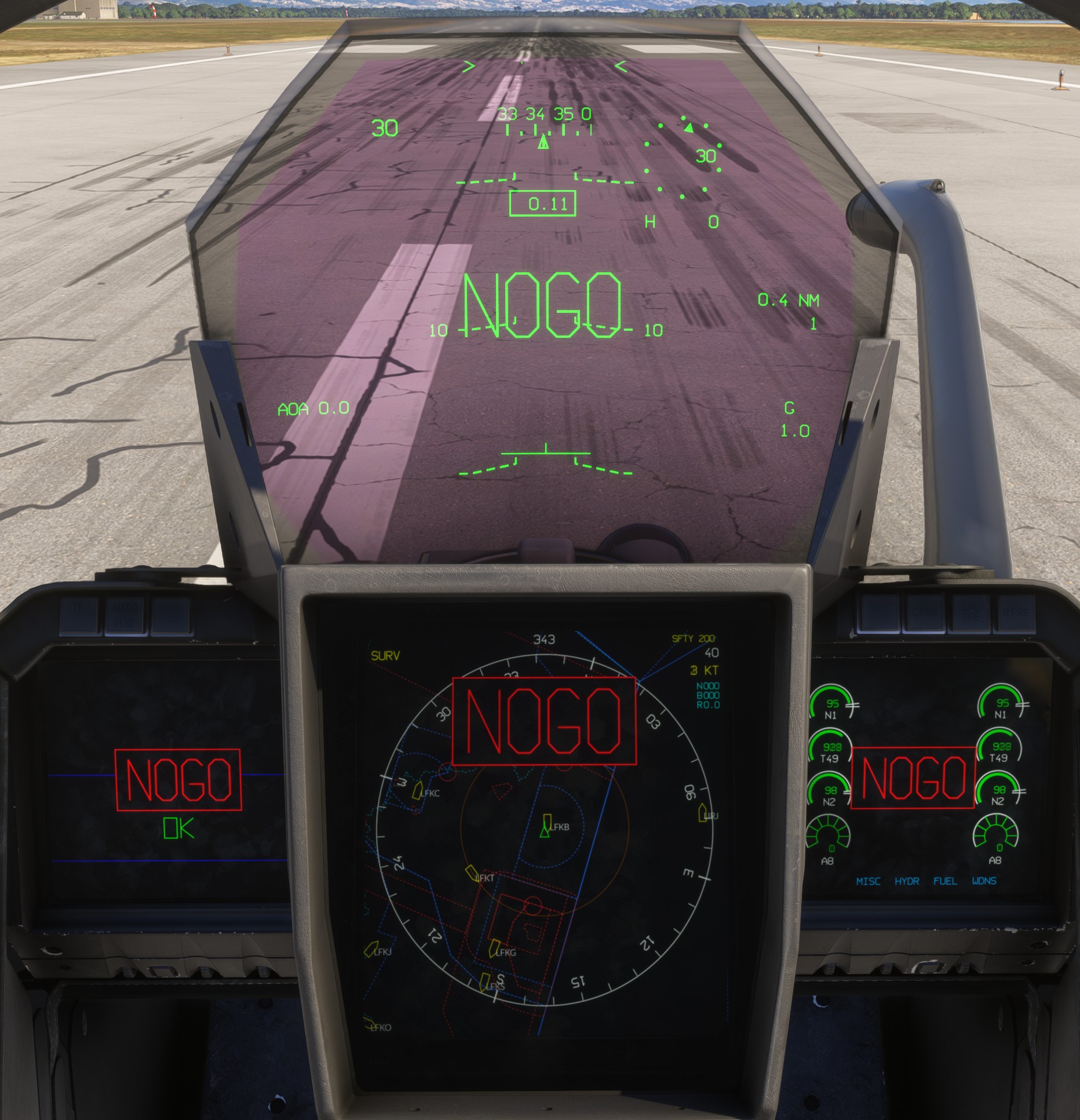
NOGO
NOGO is a dedicated flashing warning displayed whenever takeoff power is applied while the aircraft remains on the ground and one or more takeoff-critical conditions are not satisfied:
- Pitch, roll or yaw trim is not centered.
- The spoilers are not fully retracted.
- FCS emergency gain is selected.
- The FCS is operating in analogue mode.
- The spin switch is enabled.
- The FCS test switch is not in its normal position.
- The FCS test has not been successfully completed after startup.
- General Safety Switch is in the
SAFEposition.
It indicates that the aircraft is not in a configuration considered safe for takeoff and that corrective action is required before departure.