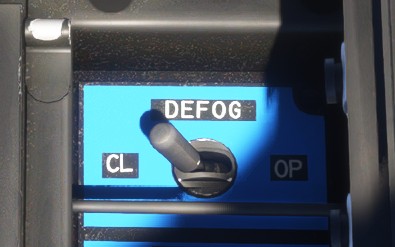
Pneumatics
Pneumatic power is supplied in the form of compressed air.
The pneumatic system is simulated and supplies several aircraft systems, including engine starting, air conditioning, cabin pressurisation and ice protection.
Bleed air
Both engines and the APU can provide bleed air for air conditioning and cabin pressurisation.
Before engine start, the APU supplies the bleed air required to drive the engine starter. Once the APU is running correctly, its indicator illuminates steady green, indicating that engine start can be initiated.
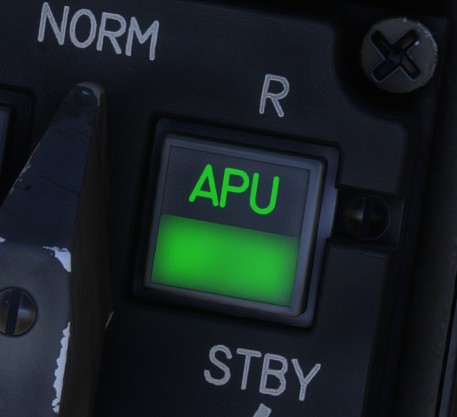
Bleed-air distribution is managed automatically, and the pilot does not normally need to operate the pneumatic valves manually.
Engine bleed air can be shut off using the emergency bleed-air switch if required (right console).
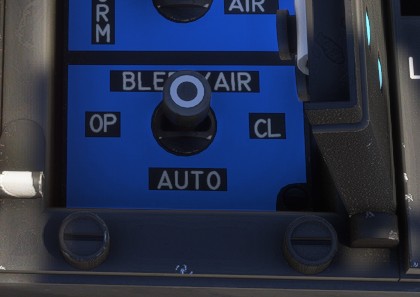
Cabin environment
The cockpit is pressurised to maintain an acceptable cabin altitude during high-altitude flight.
Cabin altitude approximately follows the relationship:
Cabin altitude = aircraft altitude / 2 + 3,000 ft
For example, at an aircraft altitude of 30,000 ft, the cabin altitude is approximately 18,000 ft.
The pilot is also equipped with an oxygen mask, which provides supplemental oxygen if cabin pressurisation becomes insufficient or is lost.
Cabin temperature can be adjusted using the temperature control knob. At least one active bleed-air source is required for the air-conditioning system to operate.
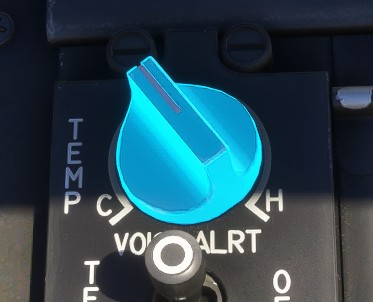
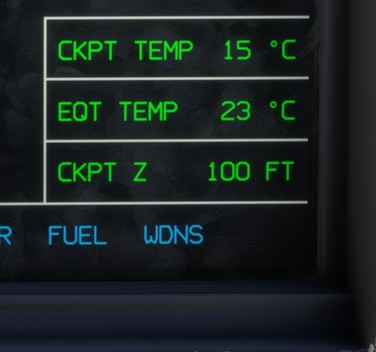
The current cabin temperature and cabin altitude are displayed on the LD MISC page.
Ice protection
Due to its usual operating speeds and flight profile, the Rafale is not normally exposed to icing for prolonged periods. However, ice may still form during low-speed flight in visible moisture and at sufficiently low temperatures.
The aircraft ice-protection system operates automatically once enabled using the associated knob-indicator.
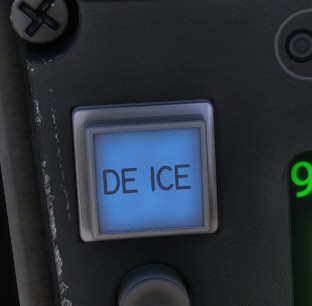
When icing conditions are detected, the relevant sensors are heated and windshield heating is activated automatically.
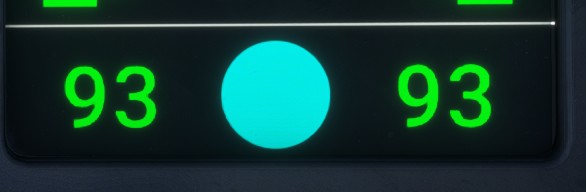
Active ice protection is indicated by a blue circle on the IMC display.
If icing conditions are detected while the ice-protection system is disabled, a warning indicator illuminates on the alarm panel.

Windshield heating can also be forced using the emergency windshield de-icing switch.